Image gallery


Sun-tracking Structures
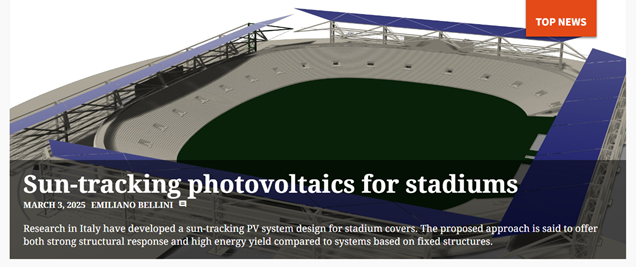
Newmatt collaborates with a research group active at the University of Salerno, University of Naples Federico II, University of Bologna, and Polytechnic University of Catalonia on a research project focused on the design and implementation of novel solar roofs for sports stadiums.
This study has been presented in two articles published by PV Magazine on October 20, 2025 (https://www.pv-magazine.com/2025/10/20/deployable-tracker-based-rooftop-pv-system-for-stadiums/) and March 3, 2025 (https://www.pv-magazine.com/2025/03/03/sun-tracking-photovoltaics-for-stadiums/).
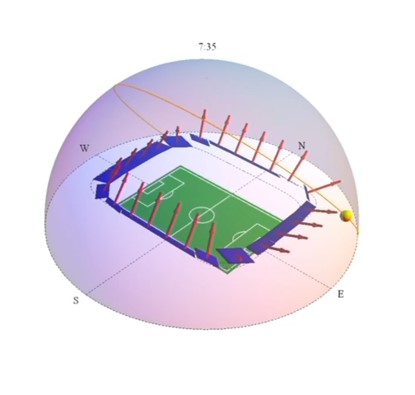
The research investigates innovative solar roof modules for sports stadiums featuring sun-tracking capabilities, which can be used both for the design of new solar stadiums and for the retrofitting of existing facilities.
Thanks to a deployable tensegrity architecture relying on folding and unfolding activation struts mounted on sliding supports, the proposed roof module can be easily integrated into existing roof structures as well as into newly designed stadiums. The sun-tracking mechanism allows the adjustment of the individual tilting angles of the different roof modules composing the stadium roof.
Illustrative examples (see the scientific articles https://www.sciencedirect.com/science/article/pii/S2666165925001711 and https://www.sciencedirect.com/science/article/pii/S0263823125001272) demonstrate that this strategy can achieve a peak output power of about 740 kW in a 10,000-seat stadium. This corresponds to approximately 74% of the estimated 1,000 kW peak power of the Stadio Marcantonio Bentegodi in Verona, a significantly larger facility with a capacity ranging between 30,000 and 39,000 seats (https://www.solarplaza.com/resource/11879/top-50-solar-/).
The energy required for deployment is minimal owing to the tensegrity-based design, which eliminates the need for pneumatic actuators. Instead, deployment is achieved through simple winch-driven adjustments of the rest lengths of activation cables.
The harvested solar energy can be used for on-site consumption—for instance, to power lighting, HVAC systems, and other stadium services—or exported to the local electrical grid, thereby contributing to the sustainability and energy autonomy of sports facilities.

neWmatt s.r.l.
Via F.A. Cappone, 29 – Condominio Ariete
83100 Avellino (AV)
Partita IVA 05690610653